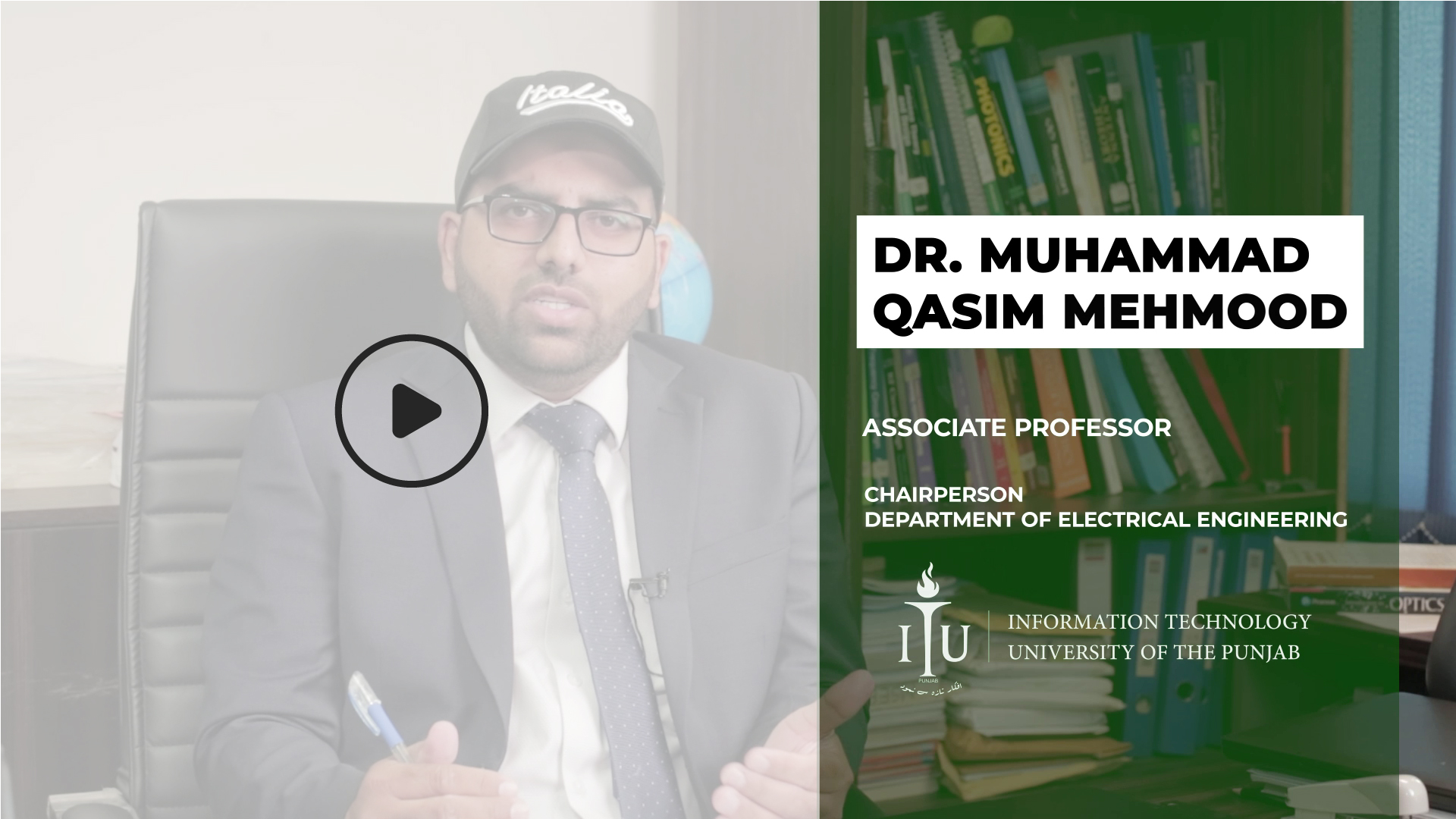
Introduction
Welcome to the Electrical Engineering Department (EED) at Information Technology University (ITU), Lahore. At ITU, our students have access to a wide array of subjects, including electronics, communication systems, control systems, power systems, microwave engineering, digital signal processing, renewable energy, bioelectronics, robotics and photonics. Our goal for students is to give them a high-quality engineering education that includes hands-on experience. Our department has one of the finest faculty in the country who have studied and worked for institutions of international repute. The faculty members are dedicated to carrying out research and involving capable students in individual projects. The Department of Electrical Engineering has a carefully designed curriculum which offers a wide range of knowledge, aiming at an integrated education and training of future technologists, entrepreneurs and engineering workforce for the private and public sector. It is important to highlight that both Higher Education Commission (HEC) and Pakistan Engineering Council (PEC) recognize BS in electrical engineering program at ITU.
ITU offers BS Electrical Engineering in the following two streams:
- Electronics Stream
- Computer Systems Stream

Objective
The Program Educational Objectives (PEO) of the BS in Electrical Engineering program are as under:
- Individuals with strong grip over core Electrical Engineering concepts to tackle real-world
- Proactive Electrical Engineers with comprehensive analytical, critical thinking and problem-solving skills
- Professionals fulfilling responsibilities, considering societal, environmental, and ethical practices with sound leadership and communication skills for adopting sustainable practices in their life
- Graduates demonstrating strong entrepreneurial spirit and a desire to further their career by involving themselves in sustained lifelong
Program Learning Outcomes (PLOs)
The curriculums have been designed to produce professional engineers with following outcomes.
PLO-1 Engineering Knowledge: Apply knowledge of mathematics, natural science, engineering fundamentals and Engineering specialization to the solution of complex engineering problems (WK-I-WK- 4).
PLO-2 Problem Analysis: Identify, formulate, conduct research literature, and analyse complex Engineering problems reaching substantiated conclusions using first principles of mathematics, natural sciences and engineering sciences(WK-I-WK4).
PLO-3 Design/Development of Solutions: An ability to design solutions for complex engineering problems and design systems, components or processes that meet specified needs with appropriate consideration for public health and safety, cultural, societal, and environmental considerations (WK-5).
PLO-4 Investigation: Conduct investigation of complex Engineering problems using research-based knowledge and research methods, including design of experiments, analysis and interpretation of data, and synthesis of information to provide valid conclusions (WK-8).
PLO-5 Tool Usage: Create, select and apply appropriate techniques, resources, and modern engineering and IT tools, including prediction and modeling, to complex Engineering problems, with an understanding of the limitations (WK-2 and WK-6).
PLO-6 The Engineer and the World: Analyze and evaluate sustainable development impacts to society, the economy, sustainability, health and safety, legal frameworks, and the environment while solving complex engineering problems (WK-I, WK-5, and WK-7).
PLO-7 Ethics: Apply ethical principles and commit to professional ethics and norms of engineering practice and adhere to relevant national and international laws. Demonstrate an understanding of the need for diversity and inclusion (WK-9).
PLO-8 Individual and Collaborative Team Work: Function effectively as an individual, and as a member or leader in diverse and inclusive teams and in multi- disciplinary, face-to-face, remote and distributed settings(WK-9).
PLO-9 Communication: Communicate effectively and inclusively on complex engineering activities with the engineering community and with society at large, such as being able to comprehend and write effective reports and design documentation, and make effective presentations, taking into account cultural, language, and learning differences (WK-I and WK- 9).
PLO-10 Project Management and Finance: Demonstrate knowledge and understanding of engineering management principles and economic decision-making and apply these to one’s own work, as a member and leader in a team to manage projects in multidisciplinary environments (WK-2 and WK-5).
PLO-11 Lifelong Learning: Recognize the need for, and have the preparation and ability for i) independent and life-long learning ii) adaptability to new and emerging technologies and iii) critical thinking in the broadest context of technological change (WK-8 and WK-9).
Eligibility Criteria
Applicants who have successfully completed their F.Sc. (Pre-Eng), F.Sc. (Pre-Med with additional Maths), ICS (with Physics), DAE or equivalent as PEC guidelines, A’ Levels, High School Diploma or International Baccalaureate, or will do so in the 2025 session.
- Scored 60% marks or above in Matriculation (Science), or equivalent examination
AND - Scored 60% marks or above in Intermediate, or equivalent examination*, with the following three subjects:
- Mathematics
- Physics
- Chemistry/Computer Studies/Computer Science
- Passed the ITU Admission test
OR
To be exempted from the ITU Admissions Test:
ECAT 2025
OR
NTS-NAT IE, NAT ICS
OR
HEC USAT-E, HEC USAT-CS
Details*
- Successfully cleared three of the below mentioned subjects in A’ Levels
- Chemistry/Computer Studies/Computer Science
- Mathematics
- Physics
- A GPA of at least B in American High School Diploma
- Scored at least 28 out of 45 points in International Baccalaureate Diploma Program
- Those applicants who have not studied chemistry during their HSSC or equivalent degree will have to take chemistry as a remedial subject/course in 1st semester after admission.
General Notes
Note: Per HEC rules, candidates who have completed 12 years of education and obtained degrees other than Matriculation (SSC) or Intermediate (HSSC) may be required to obtain an equivalence certificate from the Inter Board Committee of Chairman (IBCC), Islamabad.
AS Level and General Studies are not accepted
Admission Test
Applicants can take the ITU Admission Test, ECAT, NTS OR USAT for admission to ITU.
The ITU Admission Test will be held at the ITU campus an Arfa Software Technology Park in Lahore.
The test will be 90 mins. long and will comprise mostly of Multiple-Choice Questions
For information about dates please click here here.
Entry Test Pattern
Sample Test
Passed the ITU Admission test Or To be exempted from the ITU Admissions Test: ECAT 2024
You must have to upload the result card after declaration of result on ITU admission portal.
For information about dates please click here.
Passed the ITU Admission test Or To be exempted from the ITU Admissions Test: NTS-NAT IE, NAT ICS
You must have to upload the result card after declaration of result on ITU admission portal.
Validity: July 2023 – June 2024
For information about dates please click here.
Passed the ITU Admission test Or To be exempted from the ITU Admissions Test: HEC USAT-E, HEC USAT-CS
You must have to upload the result card after declaration of result on ITU admission portal.
Validity: July 2023 – June 2024
For information about dates please click here.
Fee Structure
New Intake 2025
| Semesters | Tuition Fee | University Dues | Semester Wise Total Fee |
| First Semester | 157,000 | 45,000 | 202,000 |
| Second Semester | 157,000 | 38,250 | 195,250 |
| Third Semester | 164,000 | 40,000 | 204,000 |
| Fourth Semester | 164,000 | 40,000 | 204,000 |
| Fifth Semester | 173,000 | 42,000 | 215,000 |
| Sixth Semester | 173,000 | 42,000 | 215,000 |
| Seventh Semester | 181,000 | 44,000 | 225,000 |
| Eight Semester | 181,000 | 44,000 | 225,000 |
| Total Degree Fee | 1,350,000 | 335,250 | 1,685,250 |
- A lump sum tuition fee will be charged for the semester as per the total required credit hours according to the approved roadmap/program structure of the respective degree program.
- The fee for a summer semester, course repeat/improvement will be charged Rs.9,200/per credit hour.
Total Annual Cost Per Student (Approx.)
Cost Per Student (2025-2026) in PKR |
|
| Total Annual Cost Per Student (Approx) | 6,73,775 |
|---|---|
| Subsidy from Provincial Government | 1,45,264 |
| Subsidy from Federal Government | 66,161 |
| Subsidy from ITU Endowment & investment incomes | 98,565 |
| Average Per Student Fees Contribution | 3,63,785 |
For BS Batches (2023, 2024)
| Semesters | Tuition Fee | Other Dues | Semester Wise Total Fee | |
| Fall-2025 | 157,000 | 38,250 | 195,250 | |
| Spring-2026 | 157,000 | 38,250 | 195,250 | |
| Fall-2026 | 164,000 | 40,000 | 204,000 | |
| Spring-2027 | 164,000 | 40,000 | 204,000 | |
| Fall-2027 | 173,00 | 42,000 | 215,000 | |
| Spring-2028 | 173,000 | 42,000 | 215,000 | |
|
240,500 | 1,228,500 |
- A lump sum tuition fee will be charged for the semester as per the total required CR hrs according to the approved roadmap/program structure of the respective degree
- The fee for a summer semester, course repeat/improvement will be charged For BS Programs: Rs.9,200/per credit hour.
For BS Batch 2022
| Semesters | Tuition Fee | Other Dues | Semester Wise Total Fee |
| Fall-2025 | 137,000 | 35,500 | 172,500 |
| Spring-2026 | 137,000 | 35,500 | 172,500 |
| 274,000 | 71,000 | 345,000 |
- A lump sum tuition fee will be charged for the semester as per the total required credit hours according to the approved roadmap/program structure of the respective degree
- The fee for a summer semester, course repeat/improvement will be charged For BS Programs: Rs.8,000/per credit hour.
Fee for International Students
| Particular | Fee for the International Students |
| Admission Fee | 50$ |
| University Dues (Per Semester) | 200$ |
- A 5% annual increment has been implemented on all dues.
- Revised approved fee structure will be implemented from Fall-2025 session.
Program Structure
Degree Structure
| Program Structure | |||
| Course Title Credit | Hours | Course Title Credit | Hours |
| Semester I | Semester II | ||
| Functional English | 3 | Ideology and Constitution of Pakistan | 2 |
| Calculus & Analytical Geometry | 3 | Differential Equations | 3 |
| Applications of ICT | 3 | Computer Programming | 4 |
| Applied Physics | 3 | Electronic Devices and Circuits | 4 |
| Linear Circuit Analysis | 4 | Digital Logic Design | 4 |
| Engineering Drawing | 1 | Electrical Workshop Practice | 1 |
| Quran Translation-I | 1* | ||
| Semester III | Semester IV | ||
| Communication and Presentation Skills | 2 | Islamic Studies | 2 |
| Complex Variables & Transforms | 3 | Linear Algebra | 3 |
| Data Structure and Algorithm | 4 | Electrical Machines | 4 |
| Electric Network Analysis | 4 | Signals and Systems | 4 |
| Numerical Analysis | 3 | Engineering Economincs | 2 |
| Occupational Health and Safety | 1 | Electromagnetic Field Theory | 3 |
| Quran Translation-II | 1* | ||
| Semester V | Semester VI | ||
| Civics and Community Engagement | 2 | Flexible Engg/Non-Eng Elective-I | 3 |
| Communication Systems | 4 | Linear Control Systems | 4 |
| Probability and Statistics for Engineers | 3 | Power Distribution & Utilization | 4 |
| Microprocessors and Interfacing | 4 | Depth Elective-II | 3/4 |
| *Depth Elective Core-I | 4 | Project Management | 2 |
| Quran Translation-III | 1* | Quran Translation-IV | 1* |
| Semester VII
Applied Machine Learning |
3/4 |
Semester VIII
Entrepreneurship |
2 |
| Depth Elective-III | 4 | Depth Elective – V | 4 |
| Expository Writing | 3 | Flexible Engg/Non-Engg Elective – II | 3/4 |
| Depth Elective – IV | 3/4 | Flexible Engg/Non-Engg Elective – III | 4 |
| Final Year Project-I | 2 | Final Year Project-II | 4 |
The choice of specialization stream is subject to actual course offering as per the interest of students.
Electives and Flexible Engg./Non-Engg.
| Category | Course Type / Stream | Courses |
|---|---|---|
| Arts and Humanities Electives (2+0) | List of Courses | • Communication and Presentation Skills • Beginner Spanish • Elementary Arabic • Elementary French • Elementary Chinese • History • Philosophy • Professional Ethics • Any other relevant course/Language decided by the HEI as per requirement. |
| Social Science Electives (2+0) | List of Courses | • Sociology for Engineers • Sociology • Social phycology • Critical Thinking • Human Resource Management • Organizational Behavior • Engineering Law • Engineering Economics • Applied Psychology • Engineering Management • Financial Management • Marketing Management • Leadership and Personal Grooming • Any other relevant course decided by the HEI as per requirement. |
| Natural Sciences (3+0) | Proposed Electives | • Multivariable Calculus • Discrete Mathematics • Numerical Analysis • Applied Chemistry • Biology or any related course appropriate for the program • Any other relevant course decided by the HEI as per requirement. |
| Electronics Stream | Depth Core I & II | • Electronic Circuit Design (Depth Core-I) • Power Electronics (Depth Core-II) |
| Electronics Stream | Proposed Elective | • Analogue Integrated Electronics • FPGA Based Digital Design • VLSI Design • Optoelectronic • Biomedical Instrumentation • Digital Signal Processing • RF and Microwave Engineering • Nanotechnology • Micro Electromechanical System MEMS • Industrial Electronics • Application Specific Integrated Circuits (ASIC) Design • Embedded System • Internet of Things (IoT) • Artificial Intelligence • Any other relevant course decided by the HEI as per requirement. |
| Computer Systems Stream | Depth Core I & II | • Computer Communication Networks (Depth Core-I) • Operating System (Depth Core-II) |
| Computer Systems Stream | Proposed Electives | • Data Base System • Digital Image Processing • Data Communication • Computer Graphics • Applied Computer Vision • Image and Video Coding • Network Protocols and Standards • Network Security • Network and System Programming • Computer Organization • Computer Architecture • Digital Systems Design • Robotics • Unmanned Aerial Vehicles (UAVs) • Cloud Computing • Cyber Security Systems • Geo-informatics • Digital Signal Processing • Digital Control • Internet of Things (IoT) • Embedded System • Artificial Intelligence • Any other relevant course decided by the HEI as per requirement. |
| Major Based Core (MBC) | Depth Communication Stream | • Electronic Circuit Design • Computer Communication Networks |
| Major Based Core (MBC) | Depth Elective | • Digital Communications • Wireless and Mobile Communications • Satellite Communications • Navigation Systems • Next Generation Networks • Internet of Things (IOT) • Wireless Network System • Telecommunications Standards & Regulations • Network Management • Telecommunications Traffic Engineering • Optical Communications • Microwave & Radar systems • Transmission & Switching System • Antenna & Wave Propagation |
| Multidisciplinary Domain (MDEE) | Proposed Electives | • Applied Mechanics • Fluid Mechanics • Thermodynamics • Surveying and Levelling • Biomechanics • Environmental Engineering • Software Engineering • Optimization Techniques • Applied Machine Learning • Optical Engineering • Mobile Application and Development • Any other relevant course decided by the HEI as per requirement. |