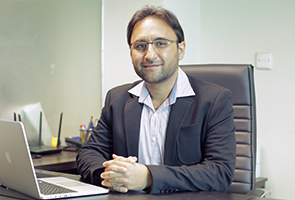
Dr. Rehan Hafiz

Professor, Department of computer and software Engineering

PhD - Electrical and Electronics Engineering, University of Manchester, UK

  • rehan.hafiz@itu.edu.pk

RESEARCH INTERESTS

His current research revolves around the Vision System Design. Recently, His currently interested in development of power efficient architectures and computing frameworks utilizing Approximate Computing techniques for Computer Vision & Image Processing Applications. Other areas of interest include FPGA based design, H/W/SW based Co-Design, Multi-Projector & Immersive Display Technologies and Image Processing & Computer Vision Applications. Currently, he leads the Vision Processing Lab  (VISpro Lab, http://vispro.itu.edu.pk/) which specifically deals with Embedded & Real-time Systems for Machine Learning, Computer Vision & AI. 

Biography

Dr. Rehan Hafiz has over eight years of R&D experience in the area of Digital Embedded Systems, Design of architectures for hardware accelerators and applied Vision &  Image Processing. Earlier, he founded the Vision Image & Signal Processing (VISpro) Lab at School of Electrical Engineering & Computer Science, NUST in 2011. Under his leadership, VISpro lab set up a joint collaboration with South Korea’s premium research organization, Electronics and Telecommunication Research Institute (ETRI), South Korea, to develop a state of the art Ultra High Definition (UHD) Panorama Generation and Multi Projector Rendering System. Such UHD based ultra-wide angle displays hold the future for next generation immersive displays. Technologies based on UHD content & projection systems shall find place in upcoming home theaters & television broadcasting systems. UHD-TV consists of extremely high resolution imagery and multichannel sound to give viewers a stronger sensation of presence. He and his team filed 7 US and Korean Patent applications, out of which two patents have already been accepted. Dr. Rehan has published several journal and conference articles related to custom processor design, approximate computing, application specific processor designing, video stabilization & multi projector rendering.

To know more about VISpro lab, log on to  http://vispro.newitu2.itu.edu.pk/

  • [1]      M. D. Shafqat et al., “Dual-Band Metasurface-Based Structured Light Generations for Futuristic Communication Applications,” Small Sci., vol. 5, no. 5, p. 2400524, 2025, doi: https://doi.org/10.1002/smsc.202400524.
  • [2]      S. Akram, M. Abdullah, K. Nasir, S. Yaqub, R. Ahmed, and R. Hafiz, “FlexEye-Application Specific Quality-scalable ISP Tuning,” Electron. Imaging, vol. 37, pp. 1–6, 2025.
  • [3]      A. Yousuf, R. Hafiz, S. Riaz, M. Farooq, K. Riaz, and M. M. U. Rahman, “Inferior myocardial infarction detection from lead II of ECG: a gramian angular field-based 2D-CNN approach,” IEEE Sensors Lett., 2024.
  • [4]      Y. Khan, Ilyas, R. Hafiz, U. Younis, and T. Tauqeer, “Modular Air Quality Calibration and Forecasting Method for Low-Cost Sensor Nodes,” IEEE Sens. J., vol. 23, no. 4, pp. 4193–4203, 2023.
  • [5]      Y. Cho et al., “CloudUP-Upsampling Vibrant Color Point Clouds Using Multi-Scale Spatial Attention,” IEEE Access, vol. 11, pp. 128569–128579, 2023.
  • [6]      “Method of training image deep learning model and device thereof,” Aug. 2023.
  • [7]      A. Hanif, R. Hafiz, and M. Shafique, “DAEM: A Data and Application Aware Error Analysis Methodology for Approximate Adders,” MDPI Inf., 2023.
  • [8]      “Apparatus and method for detecting key point based on deep learning using information change across receptive fields,” Feb. 2023.
  • [9]      J. Iqbal, R. Hafiz, and M. Ali, “Distribution Regularized Self-Supervised Learning for Domain Adaptation of Semantic Segmentation,” Image Vis. Comput., vol. 124, p. 104504, 2022.
  • [10]    J. Iqbal, R. Hafiz, and M. Ali, “FogAdapt: Self-Supervised Domain Adaptation for Semantic Segmentation of Foggy Images,” Neurocomputing, vol. 501, pp. 844–856, 2022.
  • [11]    Y. Cho et al., “Learning to Detect Local Features using Information Change,” IEEE Access, vol. 9, pp. 43898–43908, 2021.
  • [12]    M. A. Hanif, R. Hafiz, O. Hasan, and M. Shafique, “PEMACx: A Probabilistic Error Analysis Methodology for Adders with Cascaded Approximate Units,” in IEEE/ACM 57th Design Automation Conference (DAC), Jul. 2020.
  • [13]    M. Riaz et al., “CAxCNN: Towards the Use of Canonic Sign Digit Based Approximation for Hardware-Friendly Convolutional Neural Networks,” IEEE Access, vol. 8, pp. 127014–127021, 2020.
  • [14]    H. Ahmad, T. Arif, M. A. Hanif, R. Hafiz, and M. Shafique, “SuperSlash: A Unified Design Space Exploration and Model Compression Methodology for Design of Deep Learning Accelerators With Reduced Off-Chip Memory Access Volume,” IEEE Trans. Comput. Des. Integr. Circuits Syst., vol. 39, no. 11, pp. 4191–4204, 2020.
  • [15]    F. Riaz et al., “Gaussian Mixture Model Based Probabilistic Modeling of Images for Medical Image Segmentation,” IEEE Access, vol. 8, pp. 16846–16856, 2020.
  • [16]    M. A. Hanif, R. Hafiz, and M. Shafique, “Configurable Models and Design Space Exploration for Low-Latency Approximate Adders,” in Approximate Circuits: Methodologies and CAD, Springer, 2019, pp. 3–23.
  • [17]    R. Amjad, R. Hafiz, M. U. Ilyas, Younis, M. Shahzad, and M. Shafique, “m-SAAC: Multi-Stage Adaptive Approximation Control to Select Approximate Computing Modes for Vision Applications,” Microelectronics J., vol. 91, pp. 84–91, 2019.
  • [18]    A. Irshad, R. Hafiz, M. Ali, M. Faisal, Y. J. Cho, and J. Seo, “Twin-Net Descriptor: Twin Negative Mining With Quad Loss for Patch-Based Matching,” IEEE Access, vol. 7, pp. 136062–136072, 2019.
  • [19]    M. Shafique, O. Hasan, R. Hafiz, S. Mazahir, M. A. Hanif, and S. Rehman, “Approximate Computing across the Hardware and Software Stacks,” in Many-Core Computing: Hardware and Software, IET, 2019.
  • [20]    M. A. Hanif, M. U. Javed, R. Hafiz, S. Rehman, and M. Shafique, “Hardware–Software Approximations for Deep Neural Networks,” in Approximate Circuits: Methodologies and CAD, Springer, 2019, pp. 269–288.
  • [21]    M. A. Hanif, R. Hafiz, M. U. Javed, S. Rehman, and M. Shafique, “Energy-Efficient Design of Advanced Machine Learning Hardware,” in Machine Learning in VLSI Computer-Aided Design, Springer, 2019, pp. 647–678.
  • [22]    M. Shafique et al., “An Overview of Next-Generation Architectures for Machine Learning: Roadmap, Opportunities and Challenges in the IoT Era,” in Design, Automation & Test in Europe Conference & Exhibition (DATE), 2018, pp. 827–832.
  • [23]    “System and method for displaying panoramic image using single look-up table,” Jan. 2018.
  • [24]    M. A. Hanif, R. Hafiz, and M. Shafique, “Error Resilience Analysis for Systematically Employing Approximate Computing in Convolutional Neural Networks,” in Design, Automation & Test in Europe Conference & Exhibition (DATE), 2018, pp. 913–916.
  • [25]    M. A. Hanif, R. Hafiz, O. Hasan, and M. Shafique, “QuAd: Design and Analysis of Quality-Area Optimal Low-Latency Approximate Adders,” in Proceedings of the 54th Annual Design Automation Conference (DAC), 2017, p. 42.
  • [26]    M. Shafique et al., “Adaptive and Energy-Efficient Architectures for Machine Learning: Challenges, Opportunities, and Research Roadmap,” in IEEE Computer Society Annual Symposium on VLSI (ISVLSI), 2017.
  • [27]    S. Mussadiq, R. Hafiz, and M. A. Jamal, “Confined Projection on Selected Sub-Surface Using a Robust Binary-Coded Pattern for Pico-Projectors,” Multimed. Syst., vol. 23, no. 2, pp. 207–222, 2017.
  • [28]    S. Mazahir, O. Hasan, R. Hafiz, M. Shafique, and J. Henkel, “Probabilistic Error Modelling for Approximate Adders,” IEEE Trans. Comput., vol. 66, no. 3, pp. 515–530, 2017.
  • [29]    W. El-Harouni, S. Rehman, B. S. Prabakaran, A. Kumar, R. Hafiz, and M. Shafique, “Embracing Approximate Computing for Energy-Efficient Motion Estimation in High Efficiency Video Coding,” in Design, Automation & Test in Europe Conference & Exhibition (DATE), 2017.
  • [30]    S. Mazahir, O. Hasan, R. Hafiz, and M. Shafique, “Probabilistic Error Analysis of Approximate Recursive Multipliers,” IEEE Trans. Comput., vol. 66, no. 11, pp. 1982–1990, 2017.
  • [31]    M. Shafique, R. Hafiz, S. Rehman, W. El-Harouni, and J. Henkel, “Cross-Layer Approximate Computing: From Logic to Architectures,” in Proceedings of the 53rd Annual Design Automation Conference (DAC), 2016, p. 99.
  • [32]    S. Mazahir, O. Hasan, R. Hafiz, M. Shafique, and J. Henkel, “An Area-Efficient Consolidated Configurable Error Correction for Approximate Hardware Accelerators,” in Proceedings of the 53rd Annual Design Automation Conference (DAC), 2016, p. 96.
  • [33]    M. T. Ibrahim, R. Hafiz, M. M. Khan, and Y. Cho, “Automatic Selection of Colour Reference Image for Panoramic Stitching,” Multimed. Syst., vol. 22, no. 3, pp. 379–392, 2016.
  • [34]    M. Shafique, W. Ahmad, R. Hafiz, and J. Henkel, “A Low Latency Generic Accuracy Configurable Adder,” in ACM/EDAC/IEEE 52nd Design Automation Conference (DAC), San Francisco, CA, USA, 2015.
  • [35]    M. U. Kakli, H. S. Qureshi, M. M. Khan, R. Hafiz, Y. Cho, and U. Park, “Quality Assessment of Images Projected Using Multiple Projectors,” KSII Trans. Internet Inf. Syst., vol. 9, no. 6, 2015.
  • [36]    “Geometric correction apparatus and method based on recursive Bezier patch sub-division cross-reference to related application,” Nov. 2015.
  • [37]    “Apparatus and method for correcting colour of image projection device,” May 2015.
  • [38]    B. Kamran et al., “A Scalable Architecture for Geometric Correction of Multi-Projector Display Systems,” Displays, vol. 40, pp. 104–112, 2015.
  • [39]    A. Hamza, R. Hafiz, M. M. Khan, Y. Cho, and J. Cha, “Stabilization of Panoramic Videos from Mobile Multi-Camera Platforms,” Image Vis. Comput., vol. 37, pp. 20–30, 2015.
  • [40]    S. Saeed et al., “A Unified Panoramic Stitching and Multi-Projector Rendering Scheme for Immersive Panoramic Displays,” Displays, vol. 40, pp. 78–87, 2015.
  • [41]    M. Ahmad, A. Kamboh, and R. Hafiz, “Power & Throughput Optimized Lifting Architecture for Wavelet Packet Transform,” in IEEE International Symposium on Circuits and Systems (ISCAS), 2014.
  • [42]    R. Bilal, R. Hafiz, M. Shafique, S. Shoaib, A. Munawar, and J. Henkel, “ISOMER: Integrated Selection, Partitioning, and Placement Methodology for Reconfigurable Architectures,” in IEEE/ACM International Conference on Computer-Aided Design (ICCAD), 2013, pp. 755–762.
  • [43]    A. Ahmed, R. Hafiz, M. M. Khan, Y. J. Cho, and J. Cha, “Geometric Correction for Uneven Quadric Projection Surfaces Using Recursive Subdivision of Bézier Patches,” ETRI J., vol. 35, no. 6, pp. 1115–1125, 2013.
  • [44]    H. S. Qureshi, M. M. Khan, R. Hafiz, Y. Cho, and J. Cha, “Quantitative Quality Assessment of Stitched Panoramic Images,” IET Image Process., vol. 6, no. 9, pp. 1348–1358, 2012.
  • [45]    R. Hafiz and K. B. Ozanyan, “Optical Absorption Measurements in Particle-Containing Ambient Using Gated Ratiometric Detection,” IEEE Sens. J., vol. 8, no. 8, pp. 1437–1444, 2008.
  • [46]    R. Hafiz and K. B. Ozanyan, “Digitally Balanced Detection for Optical Tomography,” Rev. Sci. Instrum., vol. 78, no. 10, p. 103101, 2007.
  • [47]      “A High Throughput, Low Interrupt Generic Micro-Coded Architecture for Ultra High Speed Communication Protocols.”
  • Awarded HEC NRPU Funding on A"n advance coding scheme for wireless Communication in an unknown environment", (PI: Dr. Ali Ahmed, Co-PI Dr. Rehan Hafiz )
  • HiPEAC 2017 Award for QuAd: Design and Analysis of Quality-Area Optimal Low-Latency Approximate Adders, DAC 2017 by HiPEAC Steering Committee
  • Overseas Research Scholarship (ORS,UK) award from Universities UK (2007)
  • Engineering and Physical Sciences Research Scholarship, Manchester (2007)
    • IEEE USA
    • Pakistan Engineering Council (PEC) : COMP/02715
  • List of Patents
    • 1.        Approved Patent, “Geometric Correction Apparatus and Method based on Recursive Bezier Patch Sub-Division”, Registration No.(Date) 1014096190000 (2014.06.12) (Korean Patent Office) – Granted2.        Application No. 550/2011, “A High Throughput, Low Interrupt Generic Micro-coded Architecture for Ultra High Speed Communication Protocols”, Accepted May 2015 (Pakistan Patent Office) -- Granted3.        Application No. US 13/658,039, “Apparatus and method for correcting color of image projection device”, Filed Oct 2012 (US Patent Office)-Provisionally Accepted4.        Application No. 1020130109111, “Colour correction apparatus for panorama video stitching and method for selection of reference image thereof”, Filed 2013.09.11 (Korean Patent Office)5.        Application No. 1020120111325, “Apparatus and method for correcting color of image projection device.”, Filed 2012.10.08 (Korean Patent Office)6.        Application No. 13/678,315, “Geometric correction apparatus and method based on recursive Bezier patch sub-division cross-reference to related application”, Filed Nov 2012 (US Patent Office)7.        Application No. 14/044,405, A method for stabilization of stitched videos captured from a multi-camera platform, Filed Nov 2013 (US Patent Office)8.        Application No. 14/024,877, “Colour correction apparatus for panorama video stitching and method for selection of reference image thereof”, Filed 2014.03.13 (US Patent Office)9.        Application No. 10-2015-0047735, “System and method for displaying panorama image using single look-up table”, Filed 2015.03.03 (Korean Patent Office)